Do LinkedIn Profile-Access Services Actually Work? 6 Reddit Threads, Answered
We read six real Reddit threads about using someone else's LinkedIn profile for outreach and answered every question in them, including the ones where the skeptics are right.
Every LinkedIn profile-access vendor has an FAQ page. They all answer the same four questions. Is it legal, what does it cost, do you include Sales Navigator, which outreach tools work.
So we went and read what people ask each other when no vendor is in the room.
Six threads. Five subreddits. 136 comments. Almost none of the questions were the ones the FAQ pages answer.
The uncomfortable part: the sharpest criticism isn't from skeptics on the sidelines. It's from people who paid for access to someone else's profile, used it, and quit.
We connect companies with real LinkedIn reps for a living, so we have an obvious stake in your conclusion. We've written this so you could read it, decide none of these options is for you, and still think it was fair. Where a thread raises something we can't answer with a straight yes, we say so.
Each thread below is screenshotted in full. We've blurred the vendor names in two of them, because we can't verify those accounts and a competitor's worst day isn't our marketing. The failure patterns are what matter, and those are general.
Has anyone actually had success with someone else's LinkedIn profile?
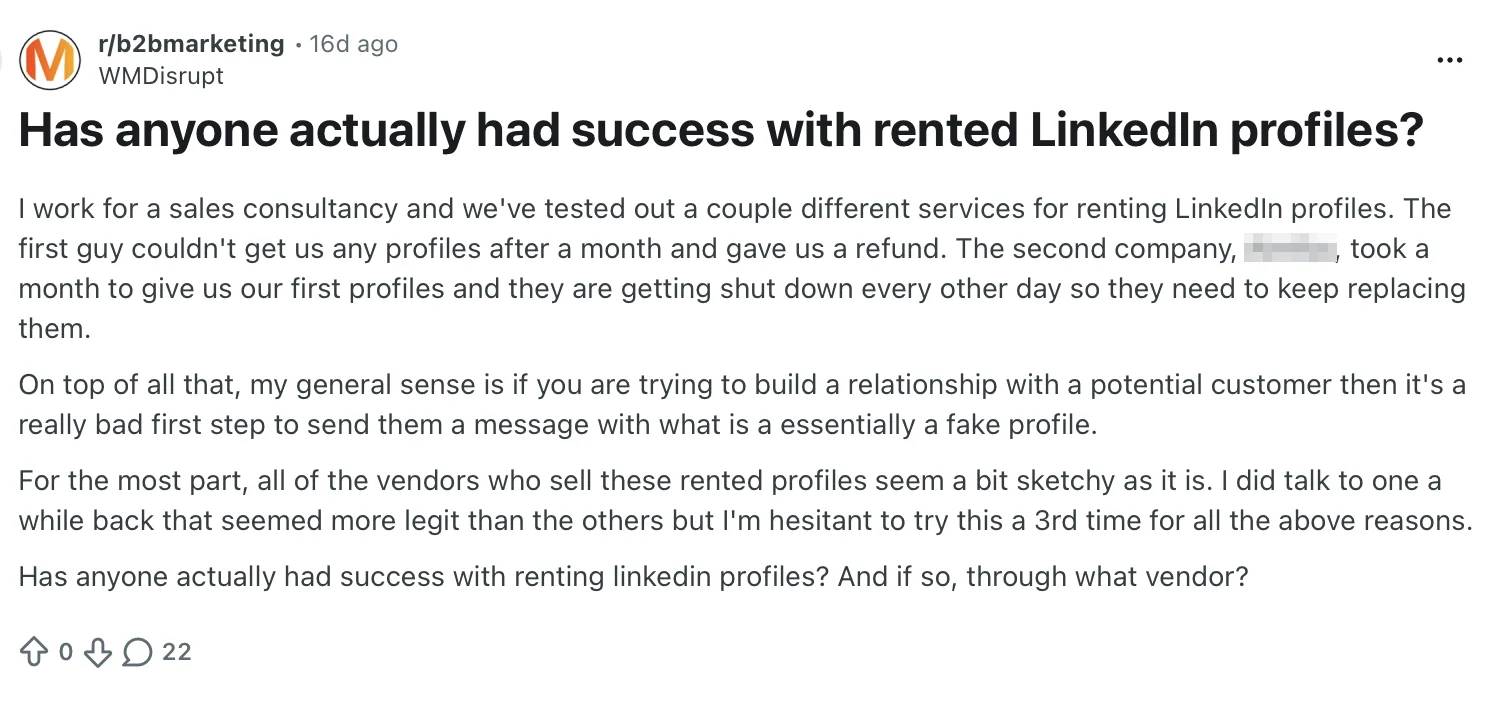
A sales consultancy in r/b2bmarketing tried two providers.
The first couldn't deliver a single profile in a month, then refunded them. The second took a month to deliver, then the profiles kept getting shut down and replaced.
Their verdict: the vendors seem sketchy, and opening with what's "essentially a fake profile" is a bad first move.
That's three failures wearing one question. They have three different answers.
Delivery time is a buying criterion nobody publishes
Two months of waiting across two vendors isn't bad luck. It's what happens when a provider sells inventory it doesn't have and sources it after you pay.
Ask any provider, in writing, before money moves: how long until my first profile is live, and what happens if you miss it?
Here's ours. Matching is immediate: you tell us your market and we match you with reps for it. There's currently a waitlist for setup, so reps go live about 10 days after you book. If we don't have a fit for your market, we say so up front.
No fit is a real outcome. We'd rather tell you on day one than day thirty.
A replacement guarantee is insurance, not an operating model
This is the line worth reframing. Profiles getting shut down every other day isn't a guarantee working. It's the product failing, with the guarantee absorbing the evidence.
Replacement should be rare. We publish a 48-hour replacement guarantee and treat frequent use of it as a defect on our side.
Because when a profile goes down, your sequences stall and your conversation history is stranded. No replacement window gives you back the week.
So don't ask a provider whether they replace restricted profiles. Everyone says yes. Ask how often they have to. Our breakdown of why real profiles stay up covers why most profile-access arrangements fall short.
The "essentially a fake profile" objection
This one is correct as written. It's the most important sentence in all six threads.
If there's no real person behind the profile, the objection stands and you shouldn't buy. Full stop.
The line that matters isn't whose name is on the invoice. It's whether a consenting, identifiable human is attached to the account: someone who exists, whose career history is real, and who can confirm who they are if LinkedIn asks.
That's the difference between a persona and a colleague you've hired. Long version: fake profiles vs. real reps.
More on vetting: how to evaluate profile providers, 5 red flags your vendor is about to disappear, and is using someone else's LinkedIn profile safe.
Do these profiles hold up? Are the connections any good? What's the ROI?
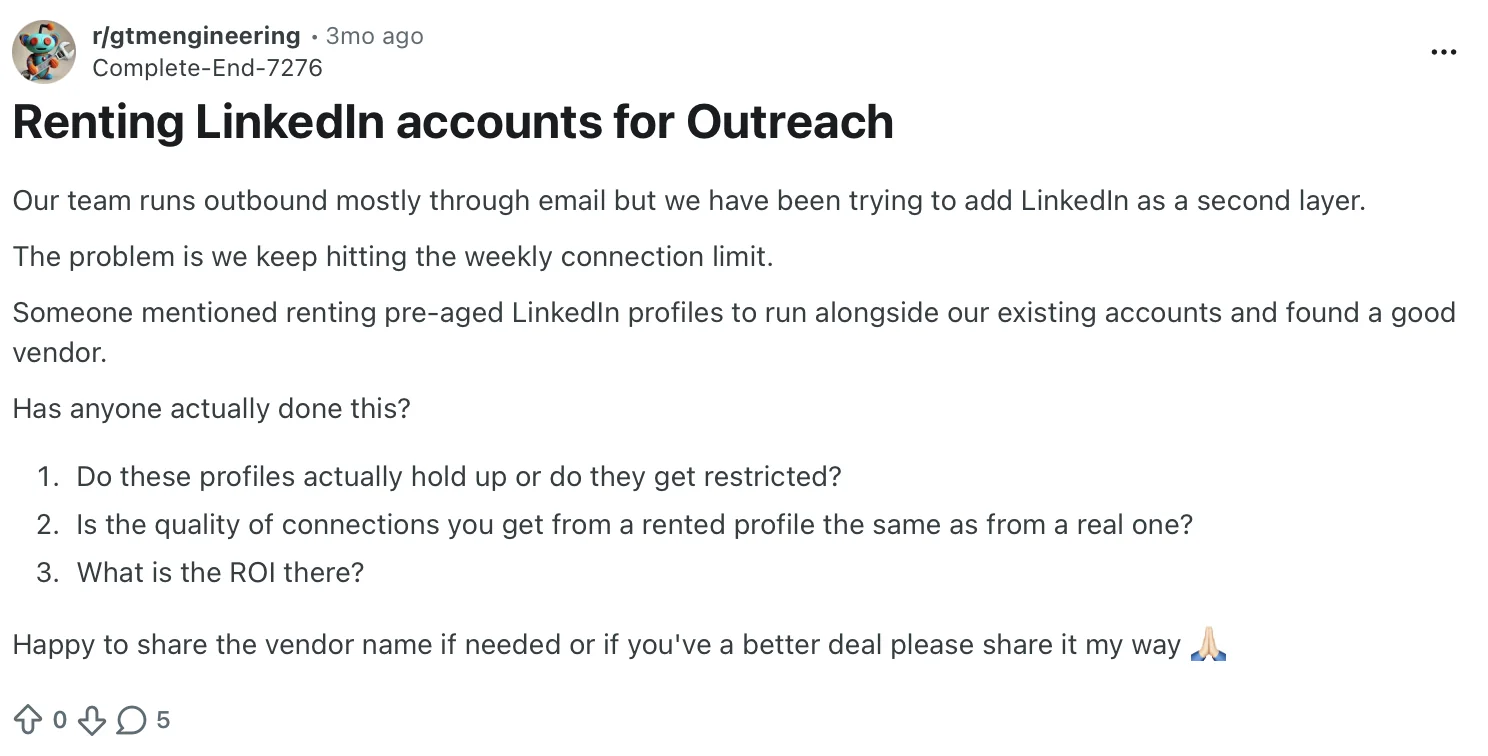
An email-first team in r/gtmengineering kept hitting the weekly connection limit. They wanted to add established profiles alongside their existing accounts. Three clean questions.
Do they hold up, or do they get restricted?
They hold up when the activity is paced. They don't when it isn't.
The pacing is unglamorous and specific. Start at 5 connection requests a day. Increase by 2 a day. Stop at 20 a day.
Keep messages around 400 characters. Space follow-ups at least three working days apart.
That 20-a-day ceiling is written into our Terms. It isn't a suggestion. The most common way a profile like this dies is a customer deciding the cap is too conservative and doubling it in week two.
Detail: LinkedIn limits explained and safe limits by scenario.
Is the connection quality the same as a real profile?
Here's the answer nobody in this industry wants to give you: you don't inherit a network matched to your ICP.
A real professional's 500+ connections are the residue of their actual career. Former colleagues. Their industry. Their city. People they met at a conference in 2019.
If you sell observability software to platform engineers, almost none of them are your buyers.
Any provider promising 500 connections inside your niche is describing something that doesn't exist at scale. Treat the promise as a warning.
What the connection base is actually worth:
- Age and history. The profile looks lived-in, not minted last Tuesday.
- Second- and third-degree reach. This changes how your requests surface.
- A credibility signal to the person deciding whether to accept.
Those are real. A warm list is not. More in account age vs. warm-up and why profile foundation drives ROI.
What's the ROI?
It depends on your ACV. For low-ACV motions, the honest answer is often don't.
Model it from a floor, not a single profile. We have a three-rep minimum, which is $525 a month to start. Three reps at the paced ceiling is roughly 900 to 1,200 connection requests a month. Build your payback math from there and your own accept-to-meeting rates.
Workings: total cost of ownership and what extra LinkedIn profiles actually cost.
If you're not sure the channel fits your economics at all, read when LinkedIn outbound works first. It will happily talk you out of it. For sizing: how many profiles you need.
I borrowed, created, bought and paid for access. All banned.
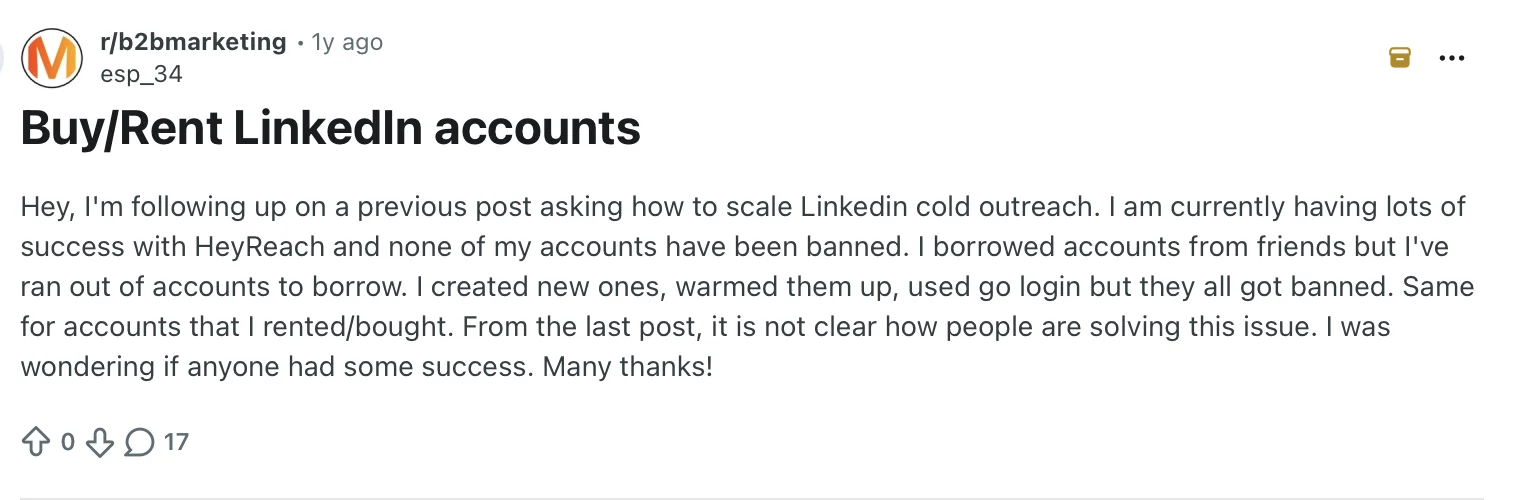
The post in r/b2bmarketing is the clearest description of the escalation ladder we've seen anywhere.
Borrowed accounts from friends until they ran out. Created new profiles, warmed them up, and used a tool to disguise where they were being used from. Banned. Bought accounts and paid for access to others. Also banned.
Every rung failed for a different reason. That's why fixing one never fixed the next.
| What they tried | Why it worked at first | Why it broke |
|---|---|---|
| Borrowing from friends | Real people, real history | Doesn't scale past your friend group, and risks someone else's account with no agreement |
| Creating new profiles | Free instant unlimited | No age no history no person behind it |
| Adding masking tools | Hides where the account is being used from | Can't manufacture a history that was never there |
| Buying accounts | Established, with connections | You can't recover what you don't own. No original owner, no verification path |
| Paying for access to real accounts, still banned | Real profiles, real owners | A real owner fixes identity, not pacing. Unpaced volume restricts a real profile too |
The masking-tool row is the expensive misunderstanding in this category.
Tools that disguise where an account is used from can't make an illegitimate profile legitimate. What makes a profile safe is a real person behind it, using their own profile, at a pace LinkedIn expects from a person.
The last row applies to us too. A real person solves identity. It doesn't solve throughput discipline. Send 60 requests a day from three reps' profiles and you'll lose three profiles instead of one. That's why the 20-a-day ceiling is in our Terms, not in a best-practice doc.
Two people have written this ladder up in full: what happened after 115 fake profiles and what happened after buying accounts. On the borrowing rung specifically: why teams move outreach off employee accounts. On warm-up: the warm-up guide.
I cancelled: the channel sucked from fake accounts
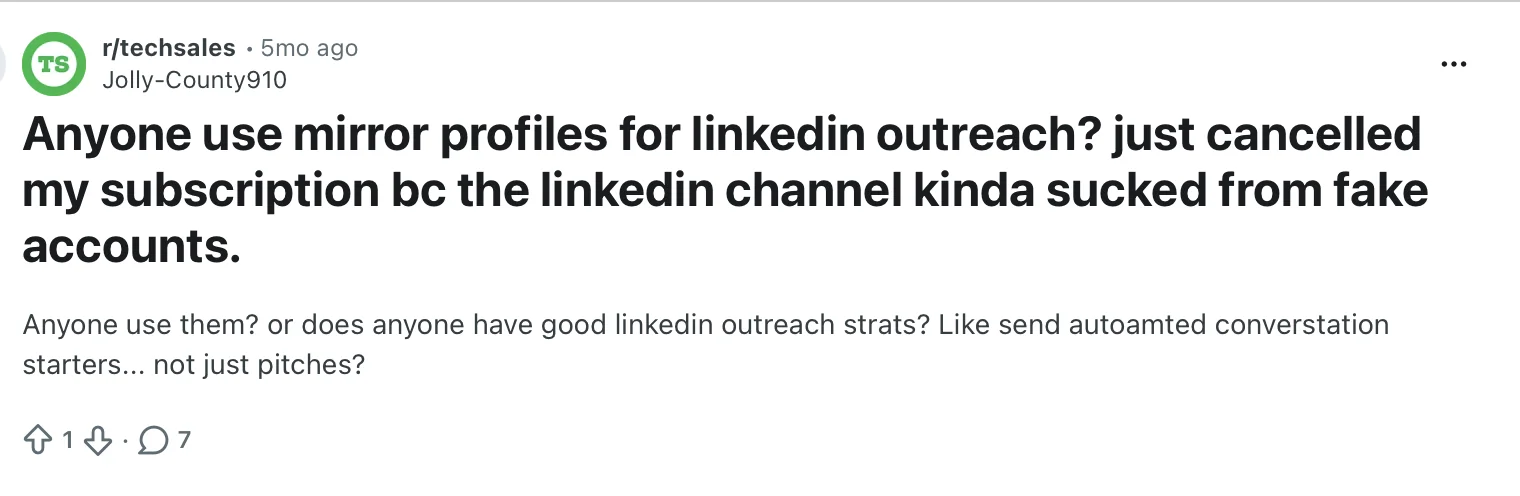
A salesperson in r/techsales cancelled their subscription because the channel underperformed. They wanted automated conversation starters, not pitches.
There are two variables in that sentence and they got collapsed into one. The profile is one. The message is the other.
A real, established, credible profile sending a pitch in the first message still fails. It just fails more politely.
The instinct that the channel degrades when the sender is obviously synthetic is right. That's the mechanism by which LinkedIn got worse for everyone.
But swapping a synthetic profile for a real one raises your ceiling. It doesn't raise your floor. If the copy is a pitch, the copy is the problem.
The diagnostic order we'd use:
- Acceptance rate first. That's mostly the profile.
- Reply rate on accepted connections second. That's almost entirely the message.
2026 outreach benchmarks gives you the numbers to compare against, so you can tell which half broke before cancelling the next thing.
On conversation starters: personalizing at scale without spamming and the real reason your automation isn't working. On synthetic senders: the dangers of fake accounts.
How do I farm LinkedIn profiles without getting banned?
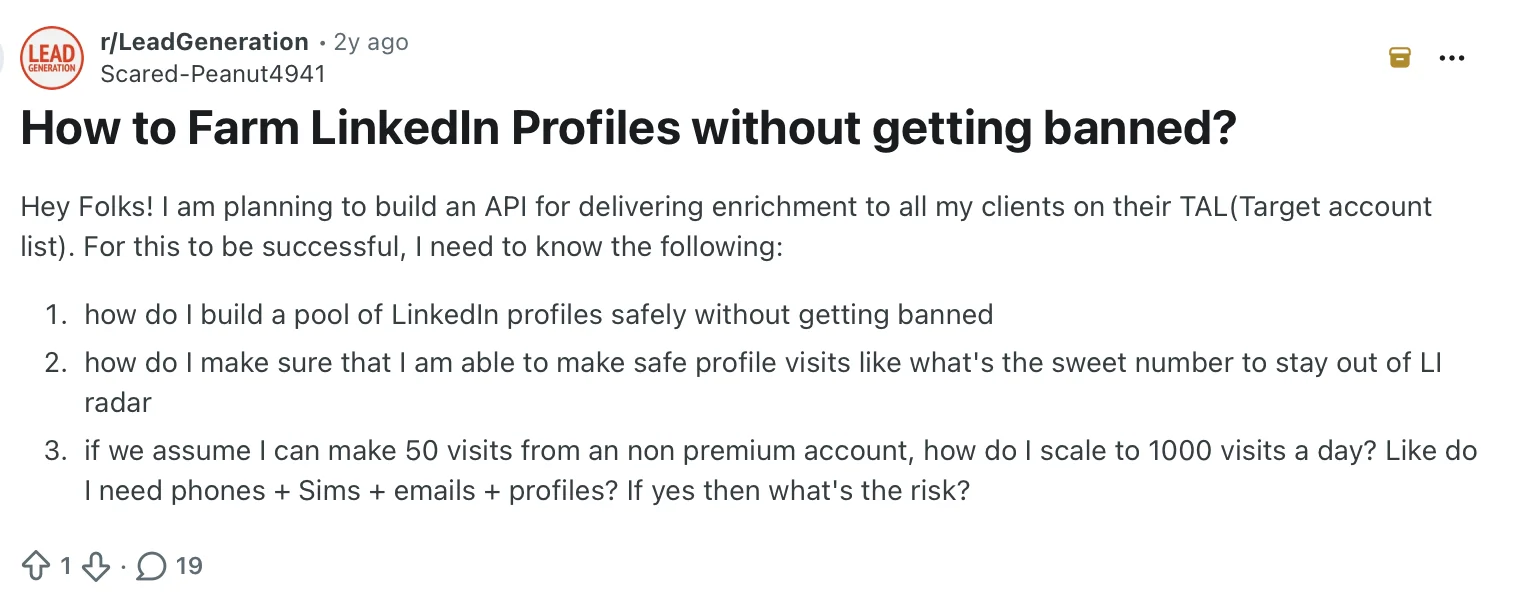
The post in r/LeadGeneration asks how to build a pool of profiles safely, what the safe number of profile visits is, and how to scale from 50 visits a day to 1,000 using phones, SIMs and emails.
This is the least commercially convenient answer in the article. That's account farming. We don't do it, and we don't think it can be made to work.
There's no safe number. The question assumes the constraint is volume. The constraint is identity.
A farmed account is detectable because there's no real person behind it. Pacing a farm just changes how long it takes to lose. The phone-and-SIM apparatus is the tell: you're building a system to simulate people instead of working with them.
See 6 mistakes that trigger instant flags.
But the real goal in that post was enrichment at 1,000 visits a day, and that reframes it. If you need data at that volume, hiring LinkedIn reps is the wrong instrument. Buy it from a data provider. It's cheaper, safer, and puts nobody's account at risk.
Nobody should hire a rep to scrape, and our Terms don't allow it. Profile visits are capped at 25-30 a day for the same reason.
If the goal is outreach volume, the math is much less exotic. Pace each profile properly, then add reps until you hit your number. See building a team of profile owners yourself and coordinating outreach across 30+ profiles.
I tried two profile-access services and couldn't change the profiles
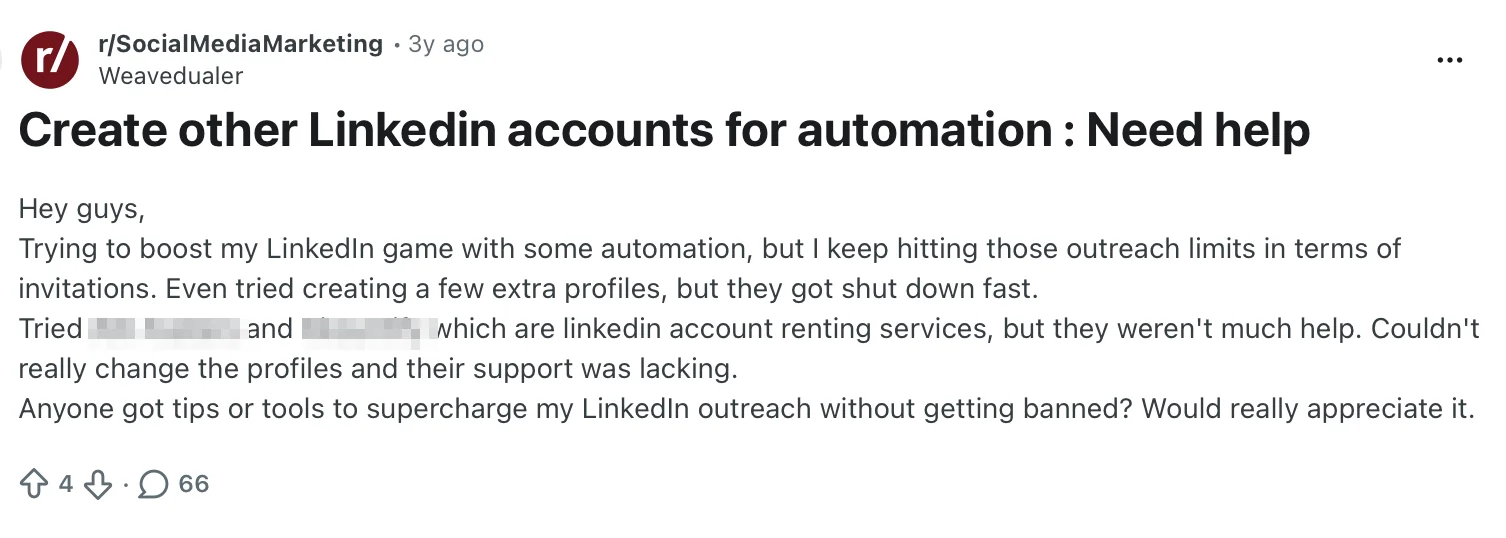
The biggest thread of the six, in r/SocialMediaMarketing, with 66 comments.
Self-made profiles got shut down fast. Two profile-access services didn't help either. The profiles couldn't really be changed, and support was thin.
The customization complaint is legitimate. It's the most under-disclosed thing in this category, and buyers usually discover it after they've paid.
So here's the specific answer instead of a reassuring one.
What you can change: the headline, the About section, the banner, all targeting, and every word of every message and sequence.
What you can't change: the rep's name, photo, location and LinkedIn URL.
That's a real constraint. Price it in before you hire.
But it isn't arbitrary, and the reason is the whole argument of this article. The name and face belong to a real person who agreed to work with you. Changing them is the exact act that turns a professional into a fabricated persona.
It's what makes profiles detectable. It's what makes the objection in thread one true.
A provider that lets you rewrite the identity wholesale isn't offering more flexibility. It's offering a fake profile with extra steps.
If editing the name and face is a hard requirement for you, no model built on real people fits. That's a fair reason to walk away from the category, not a reason to find a looser vendor.
On support: ask who answers and how fast, before you buy. Ours is dedicated Customer Success plus Slack support from 10+ reps, and our answers are on the FAQ. The walkthrough is what to do when you're matched with your first rep. For the parts you can edit: optimizing a profile for outreach.
Where the skeptics are right
Four things we won't argue with.
- If nobody real is behind the profile, don't do it. A synthetic sender is a bad opening move and it degrades the channel for everyone, including you.
- A real profile doesn't fix a bad offer or bad copy. It lifts a ceiling on volume and credibility. It can't make a message worth replying to.
- Constant replacement means something is wrong. If profiles are being swapped regularly, the guarantee is hiding the problem, not solving it. Whoever's logo is on the invoice.
- Nobody can tell you LinkedIn endorses this. The User Agreement is written around one person, one account. Hiring a rep puts a real, consenting person behind the profile, which is what makes the account recoverable and the outreach credible. That's a defensible arrangement, not an official blessing. Any vendor claiming otherwise is overselling.
What to ask any provider, including us
Every question below came out of a thread above. None are answerable with marketing copy. That's the point.
| Question | Thread | What a weak answer sounds like |
|---|---|---|
| How long until my first profile is live, and what if you miss it? | 1 | "Usually pretty quick." No number, no remedy |
| How often do you actually use your replacement guarantee? | 1, 2 | Restating the window instead of the frequency |
| Are this profile's connections in my target market? | 2 | "Yes, 500+ targeted connections" for any ICP you name |
| What's the daily activity ceiling, and is it in the contract? | 2 3 5 | "Whatever you're comfortable with" |
| Is there a real, identifiable person behind this profile? | 1 3 4 6 | Vague sourcing, or "verified" without saying by whom |
| Exactly which profile fields can I edit? | 6 | "Fully customizable" |
| Who answers when something breaks, and how fast? | 1, 6 | An email address and no response time |
The short version
The Reddit consensus on paying for access to someone else's LinkedIn profile is roughly: I tried it, it broke, and the vendors were opaque.
Having read all six threads, we think that's mostly a verdict on execution, with one real exception. A profile with no human behind it deserves every bit of the skepticism it gets.
Our conclusion is the one the threads point to: if you need more LinkedIn reach, hire a real person, give them clear limits in writing, and keep the identity theirs. Deciding whether that's worth it: the complete guide to hiring a LinkedIn rep. Been burned before and want a checklist: the provider evaluation guide. Want to see who you'd work with: meet example reps.
And if these threads convinced you this isn't for you, that's a legitimate read of the evidence.
Frequently asked questions
Does using someone else's LinkedIn profile for outreach actually work?
Yes, when three things are true: a real person is behind the profile, activity stays inside safe daily limits, and your messaging is worth replying to. Most reported failures trace back to one of those three. The exception is a profile with no real owner, where the skeptics are right.
Do these LinkedIn profiles get banned?
They get restricted when they're pushed too hard. The ceiling that keeps profiles healthy is 5 connection requests a day, ramping by 2 a day, stopping at 20 a day. Profiles sent at double that get restricted regardless of how real or established they are.
Is it legal to use someone else's LinkedIn account?
There's no law against it. LinkedIn's User Agreement is written around one person holding one account, so no vendor can honestly tell you LinkedIn endorses it. What hiring a rep does provide is a real, consenting person behind the profile, which is what makes the account verifiable and recoverable. Buying an account is a different matter and violates LinkedIn's terms outright.
How much does an extra LinkedIn profile cost?
Profile-access services run roughly $75 to $200 per profile per month across the market, varying by region, profile age and whether Sales Navigator is included. We price per rep per month: $175 at 3-4 reps, falling to $115 at 50+, with a three-rep minimum. See the full pricing breakdown or our pricing.
Do you get the connections on someone else's LinkedIn profile?
You get to reach out from a profile that has them, but they won't match your ICP. They're the accumulated network of a real person's career. Their value is profile age, second- and third-degree reach, and credibility on the accept decision. Not a warm list.
Can you change the name and photo on a rep's profile?
Not with us, and you should be cautious of providers who allow it. You can edit the headline, About section, banner, targeting and all messaging. The name, photo, location and LinkedIn URL belong to a real person, and rewriting them is what turns a real professional into a fabricated persona.