LinkedIn Verification Badges for Outreach: Helpful Signal or Liability? (2026)
LinkedIn verified badges on outreach profiles: helpful signal or liability? Learn when verification helps acceptance rates and when it raises flags.
LinkedIn's profile verification system launched as a trust signal for professional networking. The blue verification badge suggests legitimacy, thorough vetting, and reduced spam risk.
Many vendors now market "verified LinkedIn profiles" as premium offerings for B2B outreach, commanding higher prices than non-verified accounts.
But our recent testing revealed an unexpected problem: the verification badge can actually hurt credibility when targeting US prospects. Here's why, and what our data shows actually matters more for successful outreach campaigns.
What LinkedIn Profile Verification Actually Means
LinkedIn uses Persona (third-party identity verification service) to verify profiles through government-issued documents. Users can verify their identity by submitting either a passport or government ID, which LinkedIn's system authenticates.
The verification process:
- Upload government ID or passport
- Persona verifies document authenticity
- Profile receives blue verification badge
- Verification details stored in profile metadata
The badge appears on verified profiles as a trust signal, indicating LinkedIn confirmed the person's identity matches their profile information.
The Problem Nobody Talks About: Geographic Disclosure
Here's what most people miss about LinkedIn verification, and what our testing revealed creates serious credibility issues for cross-border outreach.
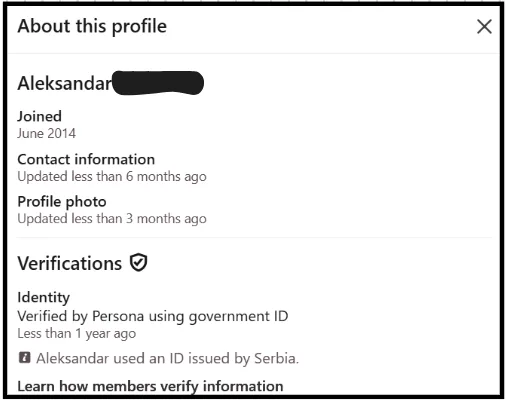
When a prospect views a verified profile, one click on the verification badge reveals the country where the ID was issued. This creates an immediate credibility problem when:
- Profile location shows "United States"
- Activity patterns suggest US-based operation
- But verification badge reveals "ID issued by Serbia" (or Poland, Ukraine, Romania, etc.)
What this tells savvy prospects:
The profile isn't actually US-based despite claims. Either the person relocated recently (raising questions about network legitimacy) or someone outside the US is using the profile while masking where they are (raising questions about authenticity).
Why Eastern European and Brazilian Profiles Dominate the Verified Market
Most vendors offering "verified LinkedIn profiles" source from developing countries where profile collaboration programs are popular supplemental income opportunities. The geographic breakdown of verified profiles offered by profile-access services reveals clear patterns:
Primary source countries:
- Mexico (ID verification available)
- Brazil (ID verification available)
- Serbia (ID verification available)
- Poland (ID verification available)
- Romania (ID verification available)
- Ukraine (ID verification available)
Why these countries dominate:
Not all countries have ID verification available; some only support passport verification. Profile owners from developing countries may not have passports (expensive, less common for domestic-focused professionals), but do have government IDs. This makes ID verification accessible while passport verification isn't.
The result: most "verified" profiles on the market come from Eastern Europe, Brazil and Mexico, creating the geographic mismatch problem when marketed for US outreach.
The Detection Risk Layered on Top
Beyond credibility with prospects, verified profiles from other countries face technical detection risks.
When a profile verified in Serbia suddenly starts showing activity that looks consistently US-based, LinkedIn's systems detect:
- Profile history inconsistency: Years of activity from one region, then sudden permanent shift
- Network composition mismatch: Connections primarily from origin country, but daily activity from new country
- Behavioral pattern shifts: Engagement timing changes from European to US business hours
This creates higher restriction risk compared to profiles that maintain geographic consistency throughout their history.
What Our Testing Actually Revealed Matters More
We tested verified and non-verified profiles across multiple campaigns targeting US B2B prospects. Results showed verification badge impact was minimal compared to four other factors:
| Factor | Impact on Performance | Why It Matters More |
|---|---|---|
| Relevant Professional Background | Very High | Experience that makes sense to the buyer builds credibility before the message is read |
| Geographic Consistency | Very High | Profile location network composition and activity patterns must align |
| Connection Count (500+) | High | Signals established professional network; improves deliverability and acceptance rates |
| Profile Completeness | High | Profile picture, education, detailed work history, skills create credibility and professionalism |
| Verification Badge | Low/Medium | Good to have, but minimal trust benefit; becomes liability when revealing geographic mismatch |
Good Example (No Badge):
- Profile: a sales professional based in San Francisco
- 600+ connections, majority US-based
- Complete work history at US tech companies
- No verification badge (nothing to click and reveal)
- Prospects see consistent US professional
Bad Example (With Badge Revealing Mismatch):
- Profile: a sender listed in New York
- 150+ connections
- Verified badge present
- One click reveals: "ID issued by Serbia"
- Prospects immediately question profile authenticity
The verification badge in the second example creates more questions than it answers.
The Better Alternative: Work Badges
Rather than prioritizing verification badges, focus on work badges from LinkedIn-recognized companies. When a profile shows current employment at a recognized organization with LinkedIn's verified company badge, this carries significantly more weight than personal identity verification, especially when the company is recognizable to your target audience.
Work badges confirm:
- Current employment at legitimate organization
- Company verified the employee relationship
- Professional credibility through institutional affiliation
This provides trust without revealing potentially problematic geographic verification details.
How to get work badges for your company:
If you're running LinkedIn outreach, whether as an outbound agency working with clients or as a sales leader at a B2B company, check if the organization qualifies for LinkedIn verification. B2B tech companies, SaaS businesses, and established enterprises often qualify but haven't completed the verification process.
Visit LinkedIn's Company Page verification requirements to see if you're eligible. Requirements typically include business registration, active company presence, and verification of ownership/admin rights.
The process is straightforward:
- Go to your LinkedIn Company Page admin view
- Look for verification options in settings
- Submit required documentation (business registration, domain verification)
- Wait for LinkedIn's review (typically 5-7 business days)
If your company doesn't qualify yet, that's fine: work badges are good to have but not required for successful outreach. Focus on the fundamentals: connection count, profile completeness, and geographic consistency matter more than badges.
FAQ
Does LinkedIn verification improve acceptance rates?
Our testing showed minimal impact. Connection acceptance rates correlated much more strongly with profile image, headline, connection count, professional background, messaging, and geographic consistency than presence of verification badge. The badge provides only marginal trust benefit that's often outweighed by geographic disclosure issues. It does not move the invitation ceiling either: what actually decides a profile's connection limit is acceptance rate and everything else the profile does with its day.
Can prospects see where my profile was verified?
Yes, absolutely. One click on the verification badge reveals the country where the ID was issued. This is public information visible to anyone viewing the profile, not hidden metadata.
Why are most verified profiles from Eastern Europe, Brazil and Mexico?
These regions have ID verification available (not just passport), making verification accessible to profile owners who may not have passports. Combined with active profile collaboration markets in these countries, they dominate the supply of verified profiles that profile-access services offer.
Should I prioritize verified profiles for US outreach?
No. Prioritize profiles with 500+ connections, relevant professional histories, a location in your target market, and US network composition. Verification badge is good to have but becomes a liability when it reveals geographic mismatch to your target market.
What's more valuable than a verification badge?
Work badges from LinkedIn-recognized companies, high connection counts (500+), complete education and work history, and consistent geographic signals throughout profile history and network composition. These create credibility without the disclosure risks verification introduces.
This is also why LINKEDSDR matches on the fundamentals rather than the badge. Every LINKEDSDR rep is a real person, not a bot or a fake profile: US-based, with an outreach-ready LinkedIn setup and 500+ connections. When the person actually lives in your target market, location, network and activity line up on their own, and there is no mismatch for a badge to reveal. See example rep profiles or what every rep includes.
The verification badge seemed like a clear trust signal when LinkedIn launched it. Our testing revealed it's far less important than basic profile quality factors, and it can actively hurt credibility when it reveals geographic inconsistencies. Focus on the fundamentals that actually drive acceptance rates rather than chasing verification status that may work against your outreach goals.